
Trading looks easy from the outside. Find a setup, place an entry, wait for the price to move and take a profit. The hard part in practice is not finding trades. It is having a process that still makes sense when the market does not behave as expected.
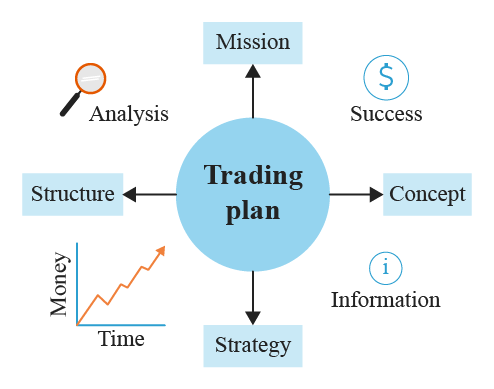
Experienced traders spend less time trying to anticipate every move the market is about to make and more time preparing for different possibilities. That is what a trading plan is designed for. It provides a framework for when to enter, how much to risk, when to exit and when to stay out of the market.
Start With a Clear Trading Objective
Before choosing a strategy, it helps to understand what the trading activity is trying to achieve.
Day trading, swing trading and longer-term positional trading require different approaches. A strategy that works for a day trader who watches the market throughout the day may not be practical for someone who checks prices only occasionally.
A trading objective should consider:
- Available trading capital
- Time available for market analysis
- Preferred trading timeframe
- Acceptable level of risk
- Exposure to different financial instruments
- Maximum loss that can reasonably be absorbed
It is easier to follow a strategy that fits the trader than one that is simply copied from someone else.
Calculate Risk Before the Trade
One of the most useful habits in trading is deciding the maximum acceptable loss before entering a position.
Suppose a trader has ₹2,00,000 in trading capital and decides that a particular trade can carry a maximum risk of 1%. The planned risk would therefore be ₹2,000.
The next step is to calculate the position size using the entry price and stop-loss level.
Position Size = Maximum Risk ÷ Risk Per Share
If the planned entry is ₹400 and the stop-loss is ₹390, the risk per share is ₹10. With a maximum planned risk of ₹2,000, the position size would be 200 shares.
This is a more disciplined approach than choosing a position size first and trying to justify the risk afterward. Position sizing combines available capital, stop-loss distance and trade size, making it a practical part of risk management.
A Stop-Loss Is More Than an Exit Order
A stop-loss should not be placed at an arbitrary percentage simply because a particular number is commonly used by traders.
The level should make sense in relation to the trading setup. Depending on the strategy, it could be placed beyond an important support or resistance level, below a recent swing low or at a point where the original trade idea is no longer valid.
There is also a practical problem with extremely tight stop-loss levels. Normal market volatility can trigger an exit even when the original trade idea is still valid. Stop placement should therefore take the asset’s volatility and the trading timeframe into account.
Most importantly, moving a stop-loss further away simply because the trade is losing changes the original risk calculation. This is often how a manageable loss can turn into a much larger one.
Risk-Reward Is Only Part of the Decision
A trade with a 1:2 risk-reward ratio may look attractive on paper, but that number alone does not make a trading strategy profitable.
The actual outcome depends on several factors, including:
- Win rate
- Average winning trade
- Average losing trade
- Transaction costs
- Slippage
- Market conditions
- Discipline in following the strategy
For example, a strategy that wins 40% of the time can still potentially be profitable if its average winning trades are significantly larger than its average losing trades. On the other hand, a strategy with a high percentage of winning trades can still lose money if occasional losses are allowed to become disproportionately large.
That is why experienced traders generally evaluate a strategy over a meaningful sample of trades rather than judging it based on one or two successful positions.
Know When Not to Trade
One of the things that separates a structured approach from impulsive trading is knowing when to stay out of the market.
There will be periods when the market is moving sideways, volatility is unusually high, liquidity is low or the setup simply does not meet the trading criteria. Not taking a trade is also a decision.
Jumping straight back into the market to recover a recent loss can easily lead to emotional decision-making. Increasing position size after a losing trade can make the situation even worse.
A trading plan should therefore include not only conditions for entering the market but also clear situations in which no trade should be taken.
Maintain a Trading Journal
Keeping a trading journal does not have to be complicated. A simple spreadsheet can be enough.
Useful information to record includes:
- Date and time of entry
- Traded instrument
- Entry price
- Stop-loss
- Target price
- Position size
- Reason for taking the trade
- Exit price
- Profit or loss
- Market conditions
- Mistakes or deviations from the trading plan
After a few weeks or months, the journal may begin to reveal patterns that are difficult to notice while actively trading.
Losses may be concentrated in certain market conditions. Position sizes may consistently be too large. Profitable setups may be getting exited too early.
The purpose of a trading journal is not to create a perfect record. It is to turn trading decisions into information that can be reviewed and used to improve future decisions.
Don’t Change the Strategy Too Frequently
One of the common mistakes among traders is changing a strategy after only a few losing trades.
Any legitimate trading approach can experience losing periods. Testing a method for five or ten trades may not provide enough information to determine whether the strategy actually works.
At the same time, there is little value in staying committed to a strategy indefinitely simply because time or money has already been invested in learning it.
A better approach is to establish evaluation criteria in advance. Once a sufficiently large sample of trades has been collected, performance can be reviewed to determine whether the losses came from the strategy itself, poor execution or unsuitable market conditions.
Protect Capital During Difficult Periods
Capital preservation becomes particularly important during periods of drawdown.
If a trading account loses 10%, it needs to gain approximately 11.1% to return to its original value. After a 20% decline, a 25% gain is required to recover the loss. As the drawdown becomes larger, the recovery becomes increasingly difficult.
That is why controlling individual losses matters. A trader does not need to avoid every losing trade. The goal is to prevent a normal losing streak from becoming a serious threat to the trading account.
Some traders also establish daily or weekly loss limits. Once the limit is reached, trading stops and resumes during the next planned session. This can help reduce the likelihood of emotional decisions after a difficult start.

How Much Is a Trading Plan Worth?
A trading plan cannot predict the market, eliminate losses or guarantee regular profits.
Its real value is much simpler: it provides a framework for making decisions when uncertainty is high.
A good plan defines the trading setup, risk level, position size, exit conditions and situations in which no trade should be taken. It also provides a structured way to review previous decisions objectively.
Markets will continue to change. Trends can turn into ranges, volatility can increase unexpectedly and strategies can go through periods of weaker performance. A trader who understands risk and follows a measurable process is generally better prepared for those changes than someone relying entirely on predictions or gut feeling.
Trading is more than simply getting the next price movement right. It is also about managing the consequences when the market proves the prediction wrong.